
What is Cysic(CYS)? The First Full-stack Compute Network


Cysic Network is a decentralized compute infrastructure under the ComputeFi vision, transforming GPUs, ASIC miners, and servers into programmable, verifiable, and liquid resources. It addresses the centralization of compute in cloud providers, prover services, and mining pools, making computation accessible like DeFi for capital. ComputeFi financializes compute, supporting workloads such as ZK proofs, AI inference, and mining in a unified marketplace.
Please read on for more details about Cysic.
Team & Background
Cysic was founded in August 2022 by a group of experts with strong technical backgrounds.
- Co-Founder: Xiong Fan
- PhD from Cornell, led ZK hardware acceleration, propelling Cysic to industry leadership via FPGA prototypes.
- Co-Founder: Bowen Huang
- Yale grad, led ZK hardware evolution from GPU/FPGA to ASIC chips, with 6-year CAS experience.
Cysic has completed multiple rounds of financing, raising a total of $21.85M.
- Seed Round: Raised $6M. Led by Polychain Capital and HashKey Capital.
- Pre-Series A Round: Raised $12M. Led by HashKey Capital and OKX Ventures, with participants including IDG Capital.
- Node Sale: Additional $3.85M raised via the Cysic platform, selling 29,000 nodes.

Technical Architecture
The architecture includes:
- Hardware Layer: Physical components like CPU/GPU/FPGA servers, mining rigs, and portable devices (e.g., cellphones, miners).
- Consensus Layer: Proof-of-Compute, integrating staked tokens and pledged computation for consensus.
- Execution Layer: Job scheduling, workload routing, and smart contracts on an EVM-compatible blockchain.
- Product Layer: Domain-specific modules for ZK proofs, AI inference, mining, and HPC, with standardized APIs for composability.

Application Scenarios
Cysic supports use cases across industries via ComputeFi:
- AI Marketplaces: On-demand ML model inference with pay-per-inference, verifiable outputs using redundancy or probabilistic methods, enabling decentralized alternatives to centralized APIs.
- Blockchain Infrastructure: Outsourcing ZK proving for rollups and L1s, distributing workloads for real-time Ethereum block proving with reduced latency and cost.
- Mining Integration: Integrating Bitcoin/Dogecoin hashpower as liquid compute, allowing flexible reallocation to ZK/AI tasks; includes portable miners for retail users.
- Scientific HPC: Affordable access for genomics, climate modeling, and 3D rendering, bypassing centralized cloud costs for open science.
Ecosystem
Testnet Phase III shows:
- 1.36M+ users
- 13M+ transactions
- 1.41M+ CYS & CGT rewards
- 264.4K+ provers & verifiers
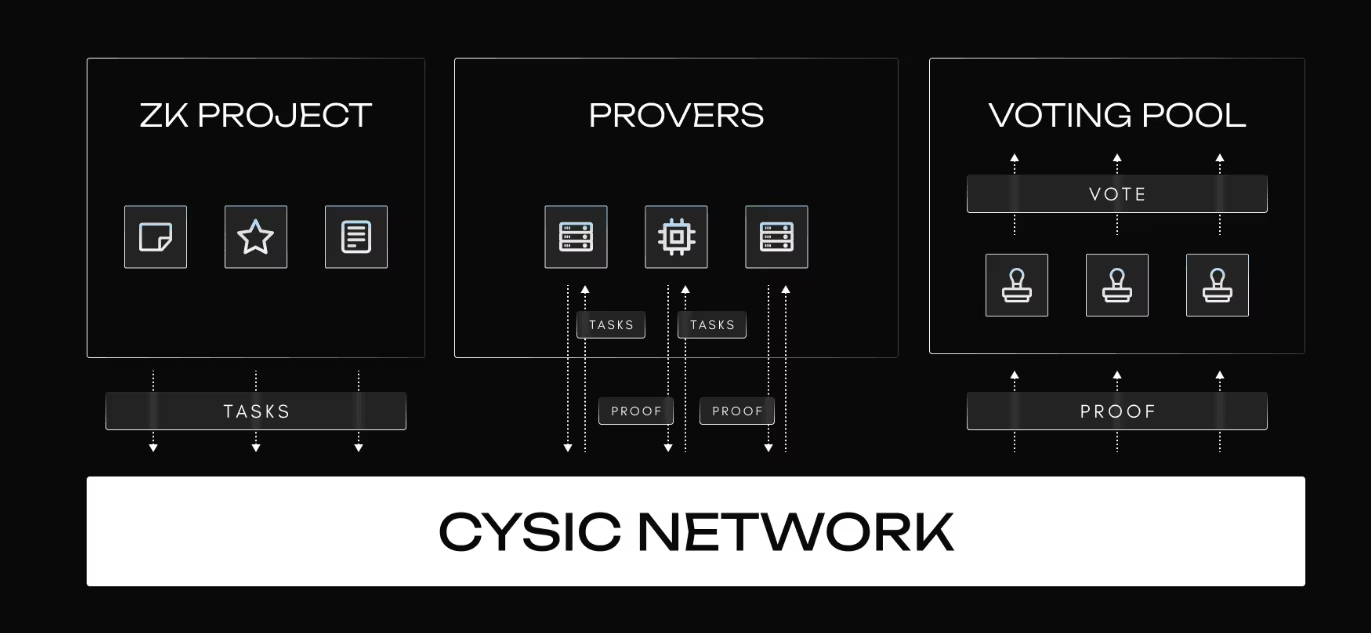
The Cysic ecosystem features core projects like Cysic ZK Prover (distributed ZK network for rollup proofs), AI Inference Hub (decentralized ML model inference), and Mining Liquidity Pool (integrating Bitcoin/Dogecoin hashpower).

Token Information
Cysic uses a dual-token model:
- $CYS: Native token for transaction fees, block rewards, and network activities; incentivizes participation and ensures liveness. Providers stake $CYS as collateral for eligibility.
- $CGT: Non-transferable governance token obtained by staking $CYS (1:1 ratio, with longer un-staking time); grants voting power for governing the compute pool. Providers reserve $CGT to defend against malicious behavior.
For more details on the token economics of CYS, please stay tuned for our updates.
Get Ready for CYS Listing on WEEX — Don’t Miss the Popular Opportunity
The long-awaited Cysic ($CYS) is coming to WEEX Exchange, giving traders early access to the first full-stack compute network. Trusted by over 5 million traders, WEEX offers a secure and seamless platform to sign up, trade, and invite friends. Watch your rewards grow like a thriving digital garden—don’t wait, your share of this exciting airdrop is just a few clicks away!
Latest Updates on WEEX
If you want to buy WXT now, you can sign up for a WEEX account
WEEX Owen: Michael Owen Joins as Global Brand Ambassador
Championing a revolutionary crypto trading experience
You may also like

What Is Hamster Kombat? Everything You Need to Know
Hamster Kombat is a Telegram-based tap‑to‑earn game where you “mine” in‑game coins by tapping and upgrading a simple…

How to Play Hamster Kombat and Earn Rewards
This guide explains how Hamster Kombat works on Telegram, how to play step by step, and practical ways…

What Is XDC Crypto? Everything You Need to Know About XDC Network
XDC crypto powers the XDC Network, an EVM-compatible, enterprise-focused blockchain built to move real-world assets and trade finance…

Is XDC a Good Investment? Risks and Opportunities Explained
XDC sits at the crossroads of enterprise blockchains and public DeFi. This article breaks down what XDC is,…

What Is APY in Crypto? A Beginner’s Guide to Annual Percentage Yield
APY tells you how much your crypto could grow in one year when interest compounds. This guide explains…

APY Explained: How Crypto Investors Earn Passive Income
APY measures how much your crypto grows in a year after compounding. This guide explains what APY means…
APR vs APY in Crypto: What’s the Difference?
APR and APY both describe yield, but they measure it differently. APR is simple interest over a year.…
Best Ways to Earn High APY in Crypto Safely
High APY in crypto can be earned from staking, lending, liquidity provision, and tokenized real‑world assets. The safest…
NFT Explained: How Non-Fungible Tokens Work in Crypto
This guide breaks down what an NFT is, how NFTs work on blockchains, and why they matter beyond…

What Is RLUSD? Everything You Need to Know About Ripple’s Stablecoin
RLUSD is Ripple’s U.S. dollar stablecoin designed for fast payments and on-chain liquidity across the XRP Ledger (XRPL)…

RLUSD vs USDT vs USDC: Which Stablecoin Is Better in 2026?
This guide compares RLUSD vs USDT vs USDC in 2026 across peg stability, reserves, regulation, liquidity, and use…

What Is GRT Crypto? A Beginner’s Guide to The Graph
GRT is the native token of The Graph, a protocol that makes blockchain data easy to find and…
How to Buy RLUSD: A Beginner’s Guide to Ripple USD
Buying RLUSD (Ripple USD) is straightforward once you know where it lives, how it’s backed, and which path—exchange…
Is GRT a Good Investment? Benefits and Risks Explained
GRT is the utility token of The Graph, a network that indexes blockchain data so apps can query…
What Are Non-Fungible Tokens (NFTs)? A Beginner’s Guide
Non-fungible tokens, or NFTs, are unique digital assets you can own, trade, or use inside apps and games.…

Kevin Warsh Fed Policy: What It Means for SpaceX Stock Price Forecasts
Kevin Warsh Fed policy announcement impact on SpaceX stock price forecasts: latest Fed rates, hawkish outlook, SpaceX valuation, IPO price, Starlink profits, and what traders should watch next.
Can RKLB Reach $200 in 2026? Rocket Lab Price Prediction
KEY TAKEAWAYS Current price: RKLB/USDT is around $105 at publication, based on market snapshots. Required upside to $200:…
If You Can’t Buy VRT Stocks, What Are the Trading Alternatives?
VRT has been one of 2026’s headline tickers, but many global users still can’t buy VRT shares through…
What Is Hamster Kombat? Everything You Need to Know
Hamster Kombat is a Telegram-based tap‑to‑earn game where you “mine” in‑game coins by tapping and upgrading a simple…
How to Play Hamster Kombat and Earn Rewards
This guide explains how Hamster Kombat works on Telegram, how to play step by step, and practical ways…
What Is XDC Crypto? Everything You Need to Know About XDC Network
XDC crypto powers the XDC Network, an EVM-compatible, enterprise-focused blockchain built to move real-world assets and trade finance…
Is XDC a Good Investment? Risks and Opportunities Explained
XDC sits at the crossroads of enterprise blockchains and public DeFi. This article breaks down what XDC is,…
What Is APY in Crypto? A Beginner’s Guide to Annual Percentage Yield
APY tells you how much your crypto could grow in one year when interest compounds. This guide explains…
APY Explained: How Crypto Investors Earn Passive Income
APY measures how much your crypto grows in a year after compounding. This guide explains what APY means…


