
Standard & Poor's Downgrades USDT to Lowest Rating, Controversy Surrounds Leading Stablecoin

Original Article Title: "S&P Gives Tether a Poor Rating, Which Stablecoins Does It Favor?"
Original Article Author: Azuma, Odaily Planet Daily
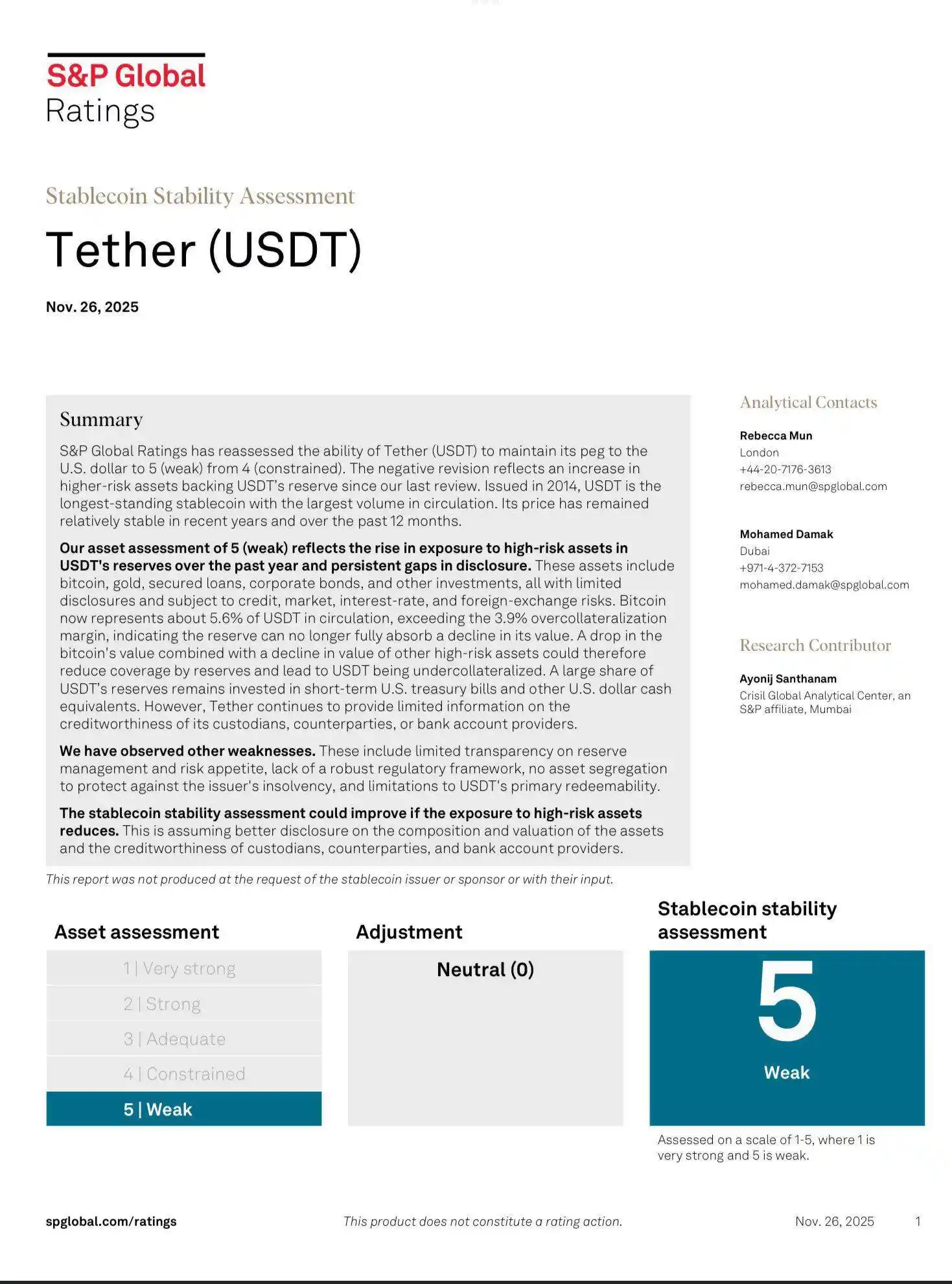
On November 26th, U.S. Eastern Time, top rating agency S&P Global announced that it had downgraded the rating of stablecoin giant Tether (USDT) from "4" (Restricted) to "5" (Vulnerable), the lowest level in its rating system.
This comes after Strategy, when S&P once again gave a staggering negative rating to the industry leader.
S&P's Rating Criteria
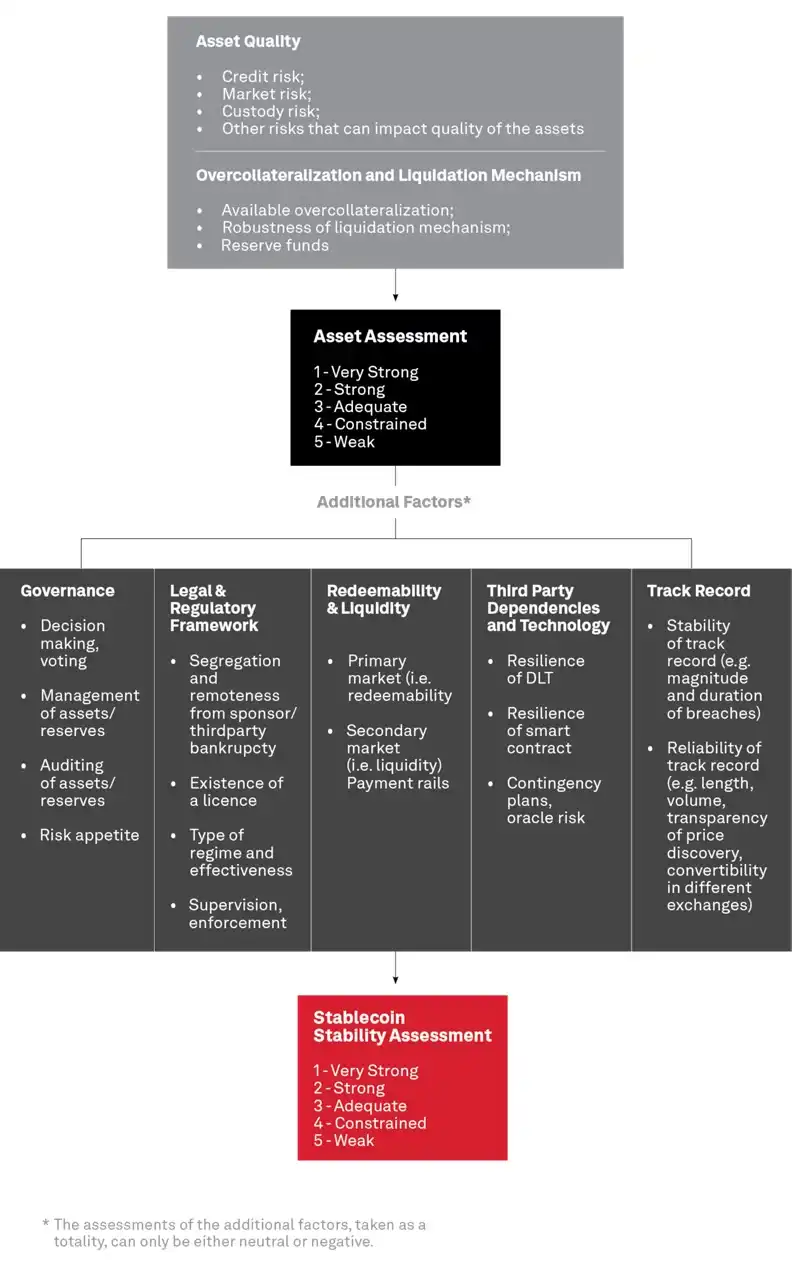
S&P, along with Moody's and Fitch, is one of the world's three major rating agencies, and is currently recognized as one of the most authoritative credit rating agencies in the international financial market. According to S&P's official introduction, its stability assessment system for stablecoins aims to provide market participants with transparency on various stablecoin stabilities, and specifically analyzes their uncoupling risks.
Specifically, S&P's analytical approach consists of the following steps:
· First, an assessment of asset quality is conducted, including credit risk, market value, and custody risk;
· Subsequently, a further analysis is made on the over-collateralization requirements of major stablecoins and the extent to which the liquidation mechanism can mitigate these risks (light gray box in the diagram below);
· Considering these factors, S&P will assign asset quality scores ranging from 1 to 5 (Strong, Good, Adequate, Restricted, Vulnerable) to each stablecoin (black box in the diagram below);
· After completing the asset quality assessment, S&P will also consider governance mechanisms, legal and regulatory frameworks, redemption capabilities and liquidity, technology and third-party dependencies, historical records, and five additional dimensions (dark gray box in the diagram below);
· The pros and cons of these five dimensions will together form an overall risk assessment view, thus influencing the final scores of each stablecoin (red box in the diagram below).
Reasoning Behind the Rating of Tether (USDT)
In its announcement about the downgrade of Tether (USDT), Standard & Poor's stated that this downgrade reflects the increased presence of medium- to high-risk assets supporting USDT's reserves since the last evaluation, as well as ongoing concerns regarding Tether's disclosure practices.
Standard & Poor's further elaborated that the so-called high-risk assets include Bitcoin, gold, secured loans, corporate bonds, and other investments, all of which have limited disclosure and face credit, market, interest rate, and foreign exchange risks. Currently, Bitcoin accounts for approximately 5.6% of Tether's reserve value, exceeding Tether's own 3.9% overcollateralization ratio, indicating that other low-risk reserve assets are no longer sufficient to fully back USDT's value. If the value of BTC and other high-risk assets were to decline, it could weaken the coverage of USDT's reserves, potentially leading to undercollateralization of USDT. As for other low-risk reserve assets, a significant portion is invested in short-term U.S. Treasury bonds and other U.S. dollar cash equivalents; however, Tether has persistently had disclosure issues regarding custodians, counterparties, or banking providers.
Standard & Poor's also added that, in addition to the main reasons mentioned above, the agency believes that Tether (USDT) also faces issues such as limited transparency in reserve management and risk preferences, lack of a robust regulatory framework, lack of asset segregation to guard against issuer bankruptcy, and restrictions on USDT redeemability.
Concluding the rating, Standard & Poor's also mentioned the potential for a rating adjustment for Tether (USDT)—if the exposure to high-risk asset reserves decreases and Tether improves its disclosure practices, it could enhance the assessment of its stability.
Rating of Other Stablecoins
Aside from Tether, Standard & Poor's has also rated several mainstream stablecoins such as USDC, USDe, with the following specific results:
· Circle (USDC): 2 (Strong);
· Circle (EURC): 2 (Strong);
· First Digital USD (FDUSD): 4 (Restricted);
· TrueUSD (TUSD): 5 (Vulnerable);
· Gemini USD (GUSD): 2 (Strong);
· Paxos Standard (PAX):2 (Strong);
· EUR Coinvertible (EURCv):3 (Ample);
· TrustToken USD (TUSD):3 (Ample);
· Ethena (USDe):5 (Vulnerable);
· Sky Protocol (USDS/DAI):4 (Restricted);
· Frax (FRAX):5 (Vulnerable);
From the above chart, it is evident that Standard & Poor's (S&P) clearly favors centralized stablecoins with overcollateralization and high transparency (such as USDC), while holding a relatively pessimistic view towards mainstream decentralized stablecoins (such as USDe, USDS) — this is also understandable, as seen from the rating logic of the previous two sections, S&P tends to classify assets like BTC as high risk, which is often a significant part of the collateral for decentralized stablecoins.
Tether's Response
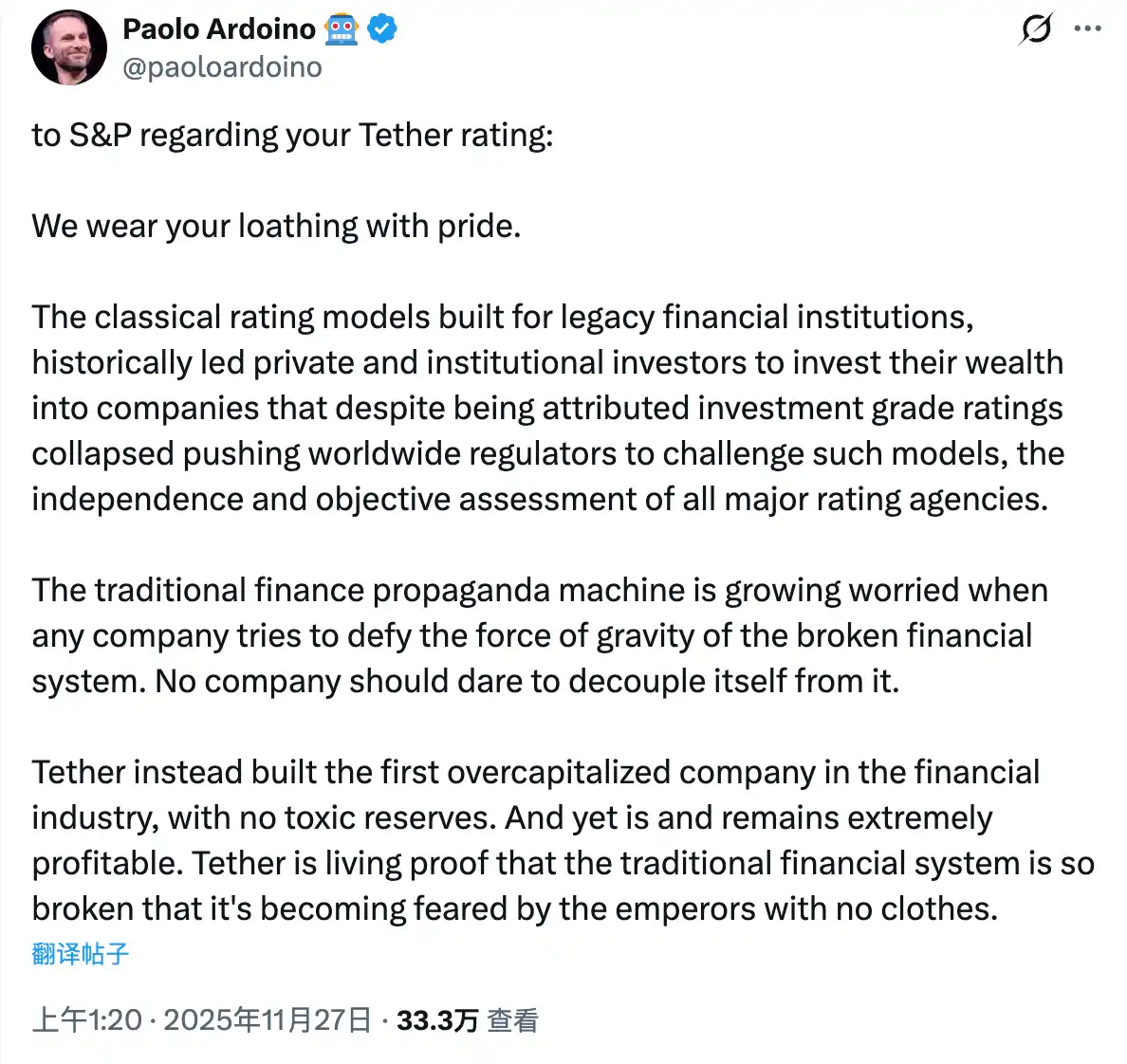
Following S&P's rating adjustment for Tether (USDT), Tether CEO Paolo Ardoino responded strongly on platform X, saying, "We take pride in your hatred."
Paolo Ardoino further stated that the classical rating models used by traditional financial institutions have led countless private and institutional investors to put their wealth into companies that, although investment-grade rated, ultimately collapsed. This has prompted global regulatory bodies to question the independence and objectivity of these models and even all major rating agencies. When companies attempt to break free from the flawed financial system's gravity, the traditional financial propaganda machine becomes increasingly fearful. There is no company that dares to attempt to break free from this system. Against this backdrop, Tether has built the first capitalized company in the financial industry, with no toxic asset reserves, and it remains highly profitable to this day. Tether's existence proves that the traditional financial system is riddled with holes, and even the "emperor with no clothes" is fearful.
Will This Impact USDT?
Looking back at S&P's rating description of Tether (USDT), apart from the changes in BTC reserve percentage, S&P has repeatedly mentioned Tether's disclosure issues.
Due to its offshore nature and some operational historical factors, Tether has always been accompanied by some controversies in terms of transparency. Compared to its biggest competitor, USDC, the lack of disclosure in reserves, audits, and other aspects for USDT is an objective fact. However, with its unparalleled liquidity conditions (especially since almost all CEXs use USDT as the base settlement currency), coupled with excellent historical performance and a strong financial position, the market still highly trusts and even relies on USDT — supported by a powerful network effect, USDT has always firmly held the throne in the stablecoin race.
As overseas influencer Novacula Occami commented: ".... the lack of disclosure has been a long-standing issue for Tether, but they are neither able nor willing to address it."
Obviously, the attitude of a mere rating agency is not enough to shake USDT's market position. However, it is worth noting that Tether has previously announced the launch of the stablecoin USAT for the U.S. market in December, and it has already been strictly regulated in terms of reserve status, regulatory registration, disclosure mechanisms, and redemption clauses through the GENIUS Act. These regulatory requirements align closely with S&P's rating standards. If Tether wants to smoothly promote USAT in the U.S. in the future, it may still need to consider S&P's rating to some extent.
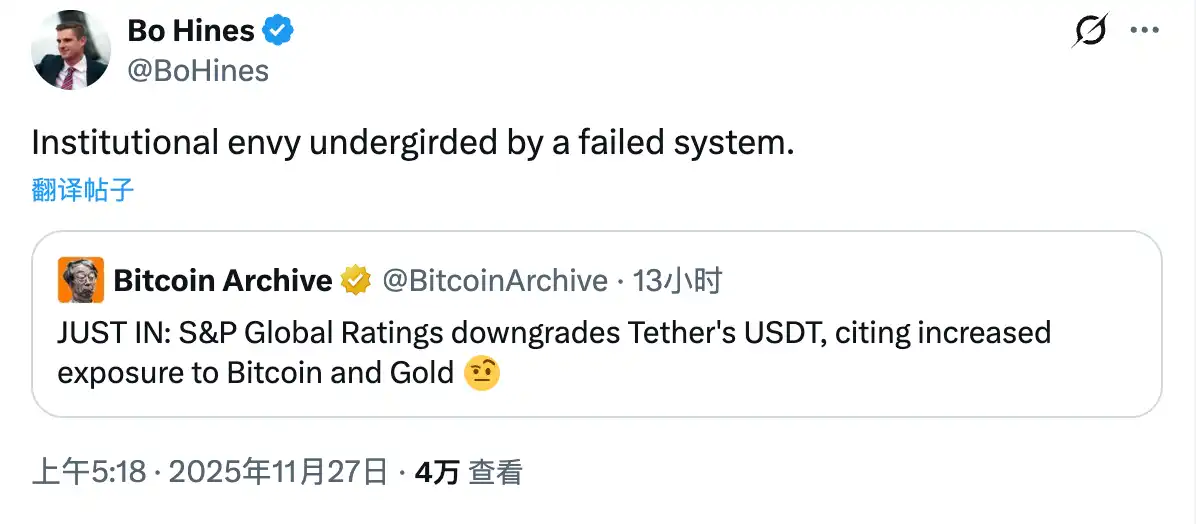
Following Paolo Ardoino's strong response to S&P today, Bo Hines, the head of Tether's USAT business, also swiftly denounced "the institutional incompetence that breeds institutional jealousy." However, despite the denouncement, while Paolo Ardoino may not need to care about S&P, Bo Hines really needs to think about how to specifically address the issues mentioned by S&P.
You may also like
Circle CEO responds to OUSD's challenge: Stablecoins are a winner-takes-all business, and we will not slow down
Argentina vs Cape Verde: When a Record-Breaking Legend Meets an Unbreakable Underdog
WEEX exclusive pre-match analysis of Argentina vs Cape Verde, exploring Messi-led Argentina’s dominance and Cape Verde’s historic defensive breakout, with a breakdown of volatility, structure, and match dynamics.
How does Gate redo "buying and selling stocks" from the cryptocurrency world to the stock market?
Former ByteDance employee's account: How I started with two Pinduoduo hard drives and made six times the profit with Seagate to achieve financial freedom?
Visa and Mastercard join 140 giants to launch a new stablecoin, but the impact on the market landscape may still be limited
WEEX Launches Depth Chart for Spot Trading
MiCA reshuffle begins, Binance temporarily bids farewell to the EU
Raising interest rates to protect STRC and selling coins to maintain credit, this time the strategy has chosen the two most expensive paths
Morning Report | Samsung announces a 265.5 trillion won investment plan, focusing on semiconductor and AI computing power data centers; Vitalik publishes an article detailing the entire technology tree behind the confusion protocol (iO) mainline
In the era of AI, what is left of Bitcoin?
NeoSoul announced plans to integrate with the OKX Agentic Wallet, promoting AI agents' participation in the on-chain economy
Why Is Bitcoin Lagging Stocks in 2026? AI Stocks, ETF Outflows, and the Nasdaq Rally Explained
What you bought on CEX is really not US stocks: Analyzing the 94% liquidation monopoly and the evaporation of equity under a five-layer pipeline
In such a crowded cross-border payment arena, where is the next stop for the future?
Why Is Bitcoin Down in 2026? What We Can Learn From 2022
The large models in the United States are moving towards closure in the name of security
From the white-haired stock god to the billionaire fund mogul, the smart people shorting Nvidia are all getting rich using the same framework
Morning Report | CoinEx becomes a key hub for Iran to evade sanctions, involving over $3.8 billion in funds; Kalshi seeks a new round of financing, with a valuation potentially rising to $40 billion
Circle CEO responds to OUSD's challenge: Stablecoins are a winner-takes-all business, and we will not slow down
Argentina vs Cape Verde: When a Record-Breaking Legend Meets an Unbreakable Underdog
WEEX exclusive pre-match analysis of Argentina vs Cape Verde, exploring Messi-led Argentina’s dominance and Cape Verde’s historic defensive breakout, with a breakdown of volatility, structure, and match dynamics.
How does Gate redo "buying and selling stocks" from the cryptocurrency world to the stock market?
Former ByteDance employee's account: How I started with two Pinduoduo hard drives and made six times the profit with Seagate to achieve financial freedom?
Visa and Mastercard join 140 giants to launch a new stablecoin, but the impact on the market landscape may still be limited
WEEX Launches Depth Chart for Spot Trading