
How AI Trading Crushes Human Traders: 5 Key Lessons from WEEX's $1.8M Trading Hackathon


Main Takeaways
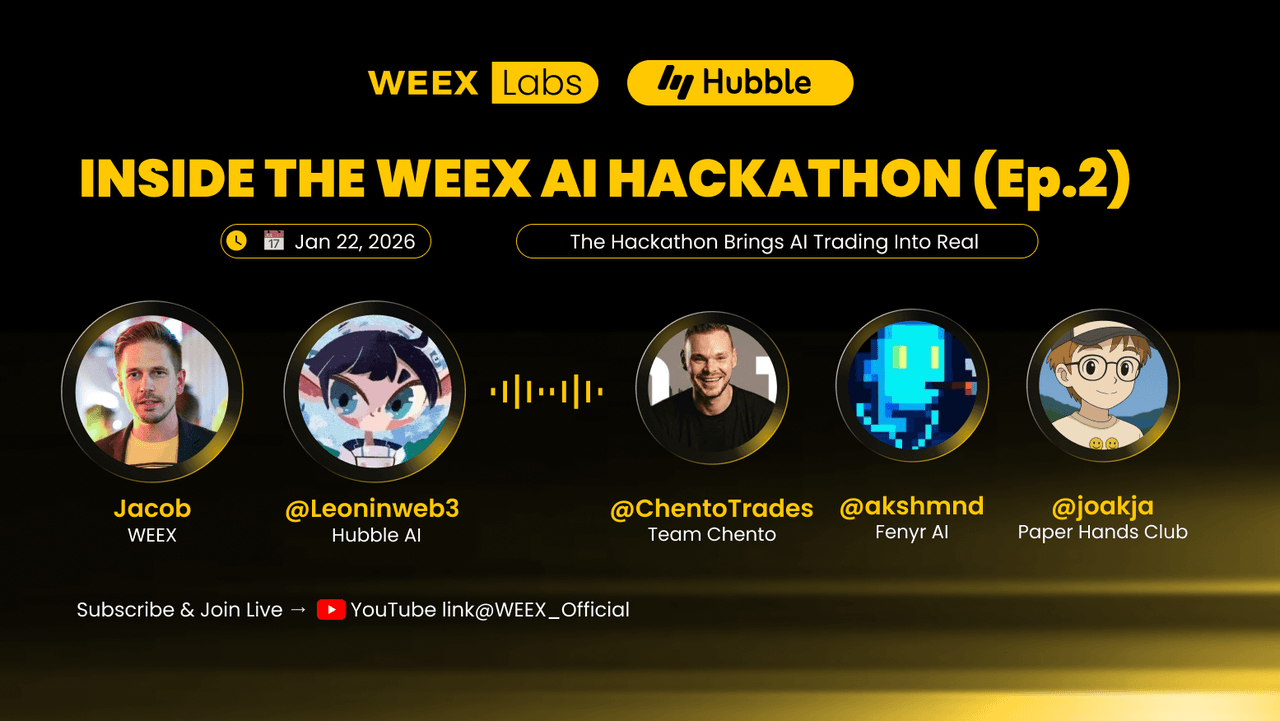
- On January 22, 2026, WEEX hosted a livestream AMA as part of WEEX's global AI trading hackathon AI Wars: WEEX Alpha Awakens, giving the community direct access to top-performing teams and co-presenting sponsor Hubble AI.
- The session enabled participating teams to address community questions and share their experiences in building and operating AI-powered trading strategies under live market conditions.
- This AMA served as a platform for transparent communication and meaningful dialogue, reinforcing WEEX’s ongoing commitment to community engagement and knowledge sharing throughout the hackathon.
In January 2026, an AI trading bot built by a Shanghai-based team outperformed over 90% of human traders during a late-night Bitcoin crash — while its creators slept.
The moment revealed why AI crypto trading is rapidly replacing manual execution. It was just one of the real-world insights shared during WEEX’s $1.88M AI Wars hackathon, where 788 teams deploy autonomous trading systems in live markets. Here are 5 game-changing lessons from the AMA.
Event Overview
As part of the ongoing AI Wars: WEEX Alpha Awakens global AI trading hackathon, WEEX hosted a livestream AMA, bringing together AI infrastructure builders and experienced traders to examine how AI-driven strategies perform in live market conditions. The session featured Leon, Co-Founder & CEO of Hubble AI, alongside competing teams including Chento, Paper Hands Club, and Akash Mondal, who shared firsthand insights on deploying AI systems under real volatility.
The discussion focused on the rise of on-chain AI agents, the limitations of backtesting, the importance of risk management and drawdown control, and whether AI represents a sustainable edge in zero-sum markets. Reflecting the core spirit of the AI hackathon, the AMA emphasized that long-term performance is defined not only by profitability, but by discipline, resilience, and execution quality when strategies are tested in live trading environments.
1 / Why Autonomous AI Agents Are Replacing Human Traders (Hubble CEO’s Prediction)
Leon, CEO and co-founder of Hubble.ai, outlined a long-term vision in which AI becomes the primary interface between traders and financial markets. He noted that the combination of crypto-native infrastructure and AI is accelerating a structural shift: from manual execution to autonomous agents operating continuously on-chain.
This vision is reflected in Hubble AI’s multi-agent architecture, which separates research, portfolio construction, risk management, and execution into distinct components. By mirroring institutional hedge fund workflows, this modular approach enables retail traders to access advanced tools previously reserved for professional trading desks, while allowing each part of a strategy to be evaluated and optimized independently.
2 / AI vs. Human Psychology in Zero-Sum Markets
A recurring theme across the panel was that AI’s immediate edge is psychological, not predictive.
Chento (@chentotrades), a hedge fund co-owner based in the Netherlands, emphasized that most retail trading failures stem from emotional bias rather than flawed strategies. Revenge trading, hesitation, and abandoning stop-loss rules remain structural weaknesses for humans in fast-moving markets.
AI, by contrast, operates without ego, fear, or external pressure — making it better suited to enforce predefined risk parameters consistently.
Chento advocated a hybrid model, where AI handles execution and risk logic, while humans retain strategic oversight during regime shifts.
3 / 24/7 Trading Without Sleep: AI's Secret to Beating Market Volatility
Joakja from Paper Hands Club, representing a Shanghai-based team, highlighted AI’s ability to operate continuously across global time zones without fatigue. His team leverages large language models for signal interpretation while enforcing strict stop-loss rules at the execution layer, enabling consistent performance across varying market conditions.
This setup allows their system to respond to market movements during periods — such as late-night volatility — when manual traders are typically inactive.
According to Joakja, the true value of automation lies in consistency, not speed alone.
4 / Risk Management 2.0: How an Indian Engineer Cut Losses with AI Automation
Akash Mondal, a blockchain engineer and machine learning specialist from India, shared how early drawdowns during the competition prompted him to reaccess his system design.
Rather than optimizing for peak returns, his revised strategy prioritizes maximum drawdown (MDD) control, treating stability as the key indicator of long-term viability.
During the livestream, Akash demonstrated a cloud-based AI agent connected to WEEX via API, capable of analyzing market data and executing trades autonomously in real time — illustrating how risk discipline is enforced at the system level rather than through manual intervention.
5 / The Future of AI Trading: Real-Time On-Chain Data Beats Price Charts
Leon noted that the next generation of AI trading systems will increasingly rely on real-time on-chain data, enabling agents to detect large wallet movements, liquidity shifts, and structural changes before they are reflected in broader market sentiment or price action.
The panel broadly agreed that while fully autonomous trading remains a long-term objective, hybrid models — where AI manages data processing and execution while humans guide high-level strategy — are currently the most effective and practical approach.
Key Takeaway: Why Hybrid AI-Human Models Dominate Trading in 2026
The WEEX AI Trading Hackathon AMA provided insight into how AI trading strategies perform under real market conditions — beyond simulations and pitch decks, and measured directly by live P&L and risk outcomes.
As the competition progresses, WEEX will continue sharing insights drawn from live performance data, contributing to a broader industry dialogue on how AI-driven and autonomous systems are shaping the future of trading.
Want to see these AI strategies in action? Watch the full AMA on YouTube: https://www.youtube.com/watch?v=h3jTwrwYoFk
or track live rankings on WEEX's hackathon leaderboard: https://www.weex.com/events/ai-trading
About WEEX
Founded in 2018, WEEX has developed into a global crypto exchange with over 6.2 million users across more than 150 countries. The platform emphasizes security, liquidity, and usability, providing over 1,200 spot trading pairs and offering up to 400x leverage in crypto futures trading. In addition to traditional spot and derivatives markets, WEEX is expanding rapidly in the AI era — delivering real-time AI news, empowering users with AI trading tools, and exploring innovative trade-to-earn models that make intelligent trading more accessible to everyone. Its 1,000 BTC Protection Fund further strengthens asset safety and transparency, while features such as copy trading and advanced trading tools allow users to follow professional traders and experience a more efficient, intelligent trading journey.
Further Reading
WEEX AI Wars AMA EP1 Recap: How AI Trading Strategies Perform in Live Crypto Markets
You may also like

SHA-256 vs Other Hashing Algorithms: What’s the Difference
This guide breaks down sha-256 alongside SHA-1, SHA-3, and MD5 in clear terms: what each hash does, where…
What Is SHA-256? How This Hashing Algorithm Works
SHA-256 is a cryptographic hashing algorithm that turns any input—short or long—into a fixed 256-bit output. Think of…
Leverage Trading Risks Every Beginner Should Know
Leverage can amplify gains and losses in crypto derivatives. This guide breaks down why leverage trading carries extra…
How to Calculate Leverage and Position Size?
Leverage lets you control a larger position with smaller capital. This guide shows how to calculate leverage and…
What Is Leverage in Trading? A Complete Guide
Leverage lets you control a larger position with a smaller amount of capital, but it also raises the…
What Is Initial Margin vs Maintenance Margin
Margin trading lets you control a larger crypto position with less capital, but it also introduces liquidation risk.…
What Is a Limit Order? A Beginner’s Guide
A limit order lets you set your own price. Your trade only executes if the market reaches that…
When Market Orders Can Cost You More Than Expected
A market order is simple: you click buy or sell, and the trade executes at the best available…
Market Order vs Limit Order: Which Should You Use
Choosing between a market order and a limit order comes down to one trade-off: speed versus price. This…
What Is a Market Order? A Beginner’s Guide
A market order is the simplest way to buy or sell: you tell the exchange to execute immediately…
Is SHA-256 Still Secure in 2026?
Updated: 2026-07-08 SHA-256 underpins Bitcoin mining, block integrity, and countless wallets and exchanges. This article explains whether SHA-256…
How SHA-256 Secures the Bitcoin Blockchain
SHA-256 is the cryptographic hash function that powers Bitcoin’s proof-of-work and the chain of blocks. This article explains…
What Happens When You Get Liquidated on Leveraged Trades?
Leverage lets you control a large position with a small margin, but it also narrows the price move…
How Margin Calls Work and How to Avoid Them
Margin trading lets you borrow against your collateral to amplify exposure, but it also introduces the risk of…
Margin Trading vs Spot Trading: What’s the Difference
Margin trading lets you borrow funds to amplify exposure, while spot trading uses only your own capital to…
What Is Margin Trading? A Beginner’s Guide
Margin trading lets you use your own funds as collateral to borrow extra capital, so you can take…
What is The White Bull (LEVI) Coin? Everything You Need to Know Before Trading LEVI/USDT
This article explains what The White Bull (LEVI) is, why it’s drawing attention on Solana, and how LEVI/USDT…
Should You Store Large Crypto Holdings in a Cold or Hot Wallet
Choosing between a cold wallet and a hot wallet is not just a preference—large crypto holders face a…
SHA-256 vs Other Hashing Algorithms: What’s the Difference
This guide breaks down sha-256 alongside SHA-1, SHA-3, and MD5 in clear terms: what each hash does, where…
What Is SHA-256? How This Hashing Algorithm Works
SHA-256 is a cryptographic hashing algorithm that turns any input—short or long—into a fixed 256-bit output. Think of…
Leverage Trading Risks Every Beginner Should Know
Leverage can amplify gains and losses in crypto derivatives. This guide breaks down why leverage trading carries extra…
How to Calculate Leverage and Position Size?
Leverage lets you control a larger position with smaller capital. This guide shows how to calculate leverage and…
What Is Leverage in Trading? A Complete Guide
Leverage lets you control a larger position with a smaller amount of capital, but it also raises the…
What Is Initial Margin vs Maintenance Margin
Margin trading lets you control a larger crypto position with less capital, but it also introduces liquidation risk.…